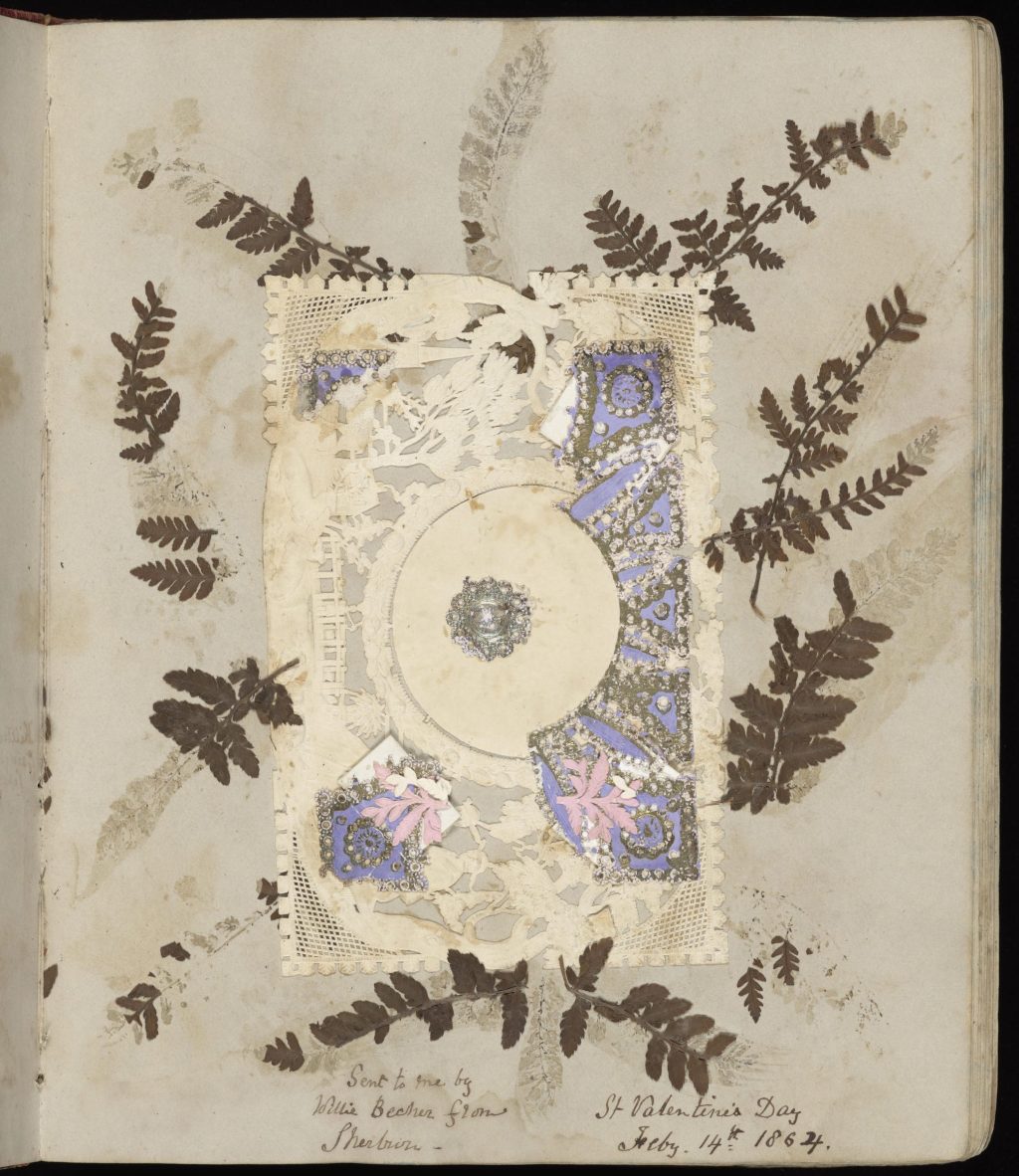
Meet Charlotte Sutton, nineteenth-century nature enthusiast, though the intricate pages of her scrapbook…
Although scrapbooking has its origins in the commonplace books of the fifteenth century, in the nineteenth century, several factors combined to bring about an explosion in the popularity of this delightfully eclectic hobby. The Industrial Revolution led to the widespread availability of cheap paper; this, along with increasing rates of literacy, led to the growth of print culture, which provided a steady stream of articles, illustrations, calling cards, postcards and other ephemera, which could form the basis of a scrapbook. But paper mementoes weren’t the only items commonly collected in the Victorian era: pressed flowers and seaweeds were widely arranged and preserved between the pages of books. These intricate displays were part collage and part citizen science, giving the wider public – and women in particular – a respectable way to participate in the increasing popular field of natural history. In some instances, they could even perform a similar function to a diary, with samples collected as souvenirs of trips or to mark important dates in a person’s life.
One such scrapbook held at Manuscripts and Special Collections is the compendium compiled by Charlotte Sutton (née Nelthorpe, 1817-1872) from 1864-1865. Charlotte was the sister of the 8th (and final) Baronet Nelthorpe, and after his death in 1865, his estate – including Scawby Hall, the family seat – passed to her husband, the Reverend Robert Sutton. Though, therefore, this scrapbook documents her life on the precipice of a transformative moment, its focus is considerably more every day, consisting of keepsakes from day trips and from her many children.
The volume begins with a bang on New Year’s Day 1864, with a range of festive mementoes including a resplendent New Year’s card and some plant cuttings taken from walks taken by Charlotte on both Christmas Day and New Year’s Day.
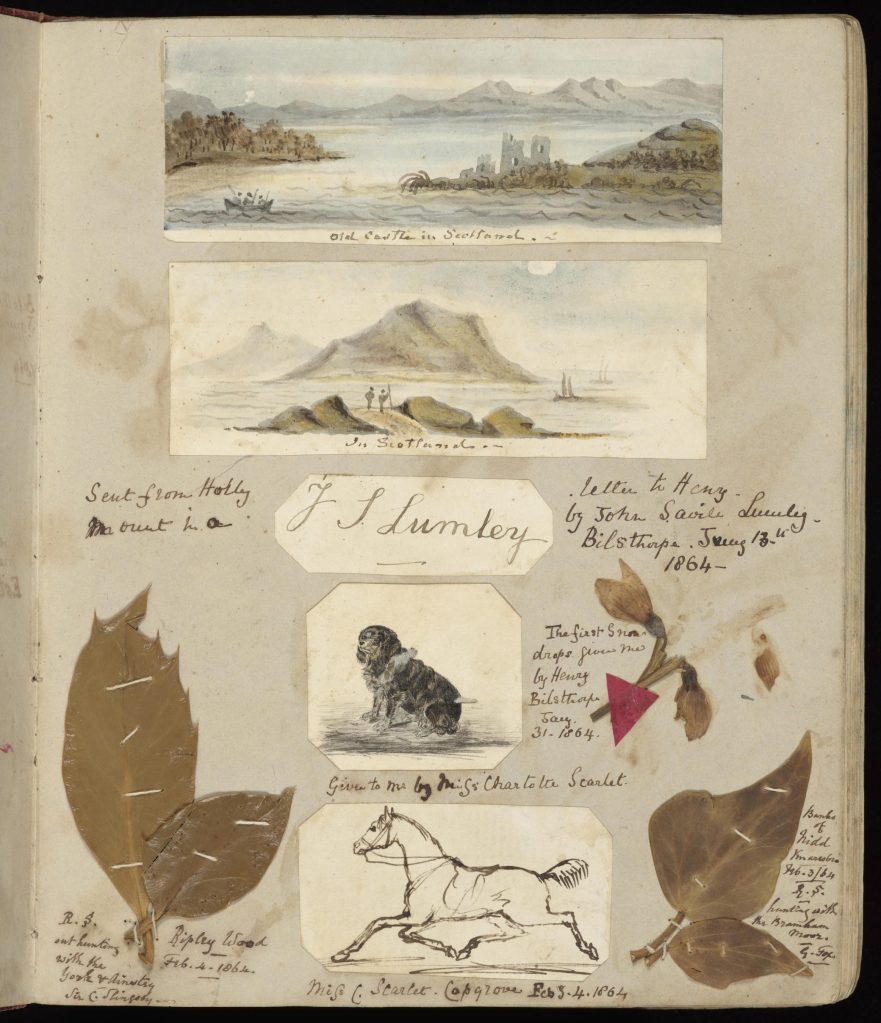
Charlotte often interspersed her natural collection with keepsakes from her children, and occasionally these two interests intersected: for instance, in March 1864, she pasted in three sketches of small shore-dwelling animals gifted to her for her birthday by her three youngest children. She also maintained a correspondence with her eldest son, Robert Nassau, dedicating half a page to a sketch of the ‘Ruins of Sardis’, which the fourteen-year-old had sent to her from boarding school, suggesting a warmth between the two, in spite of the distance between them, and what we might today conceptualise as the typically teenage desire for independence.
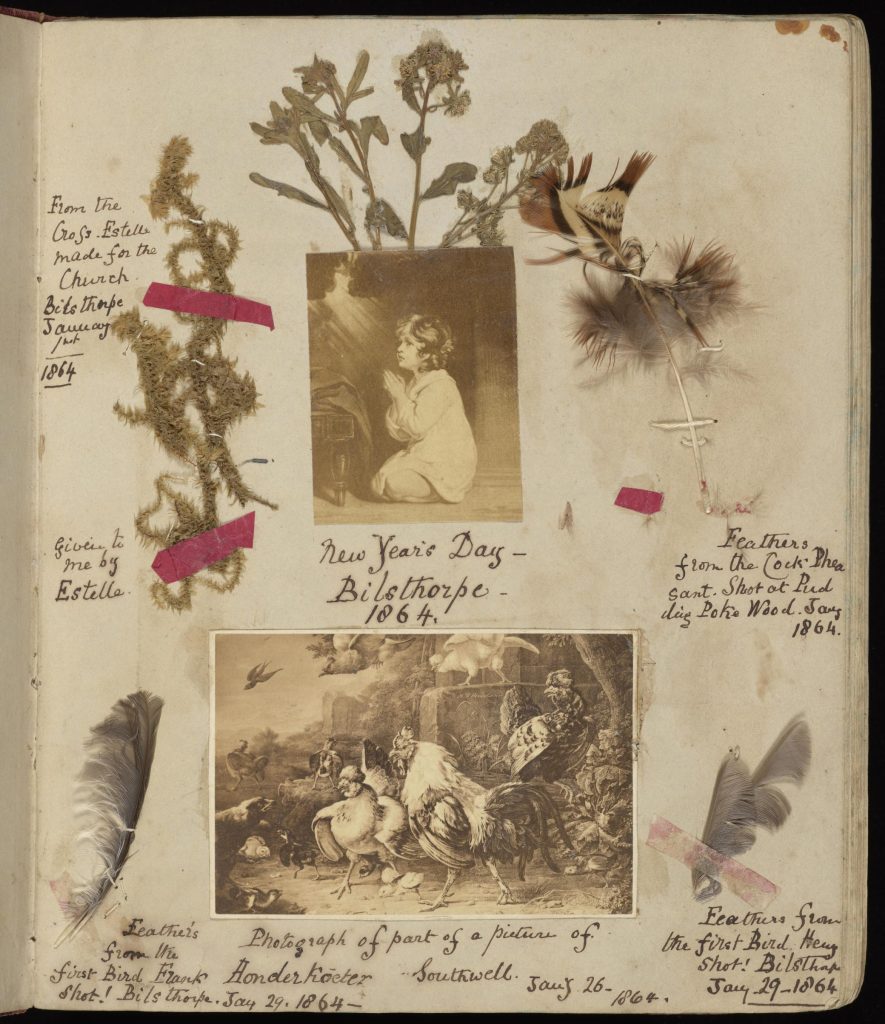
Beyond flowers and family mementos, Charlotte also collected some slightly more unusual items. In particular, she seems to have had an interest in birds and pasted feathers from what she considered to be the most interesting specimens into her scrapbook. A small bright orange tuft came, apparently, from ‘Mrs Lumley’s Parrot’, on 19th August 1864. Who exactly Mrs. Lumley was, not to mention her parrot, is unfortunately unknown.
There is much less mystery surrounding an equally exotic enclosure: a trio of Emu feathers which are labelled as coming from the Entrance Hall at Normanby Hall on 16th September 1864. Presumably, this was collected from a taxidermy emu or from a natural history display of some kind. It seems that the owners of that property, the Sheffields, were unconcerned by Charlotte’s penchant for trophy-hunting, as her scrapbook indicates that the Suttons were regular guests at Normanby. While both these specimens are quite striking, the most outlandish of her avian acquisitions was undoubtedly the intact claw of a small bird, pasted and preserved on a page as though it were simply another of the dried leaves which lie beside it.
We only have this one scrapbook, and we don’t know if Charlotte had others that have either not survived or have become separated over the years, or if this was the only one she created. Either way, we are incredibly lucky that we are able to look after it and share it with you.


Leave a Reply